
The EO DataHub provides access to datasets from trusted sources, supported by transparent quality information to help users understand how data has been validated and whether it is suitable for their needs.
Quality assurance is embedded across the platform to support confident use of Earth Observation data for research, policy and commercial applications.
Look for the quality-assured checkmark on datasets within the catalogue. Alternatively, select the 'Available QA' filter.

The EO DataHub includes a dedicated Quality Assurance (QA) service, led by the National Physical Laboratory (NPL), providing clear and accessible information about dataset quality.
The aim of the QA Service it to help users, both expert and non-expert alike, understand how data has been created and whether it is suitable for their needs.
With support from the QA service, the EO DataHub provides:
Datasets are assessed through defined validation processes to ensure they meet expected performance standards and are suitable for use across a range of applications. The QA information is embedded across the platform, allowing users to assess data as part of their workflow and thereby supporting confident use of Earth Observation data across research, policy and commercial applications.
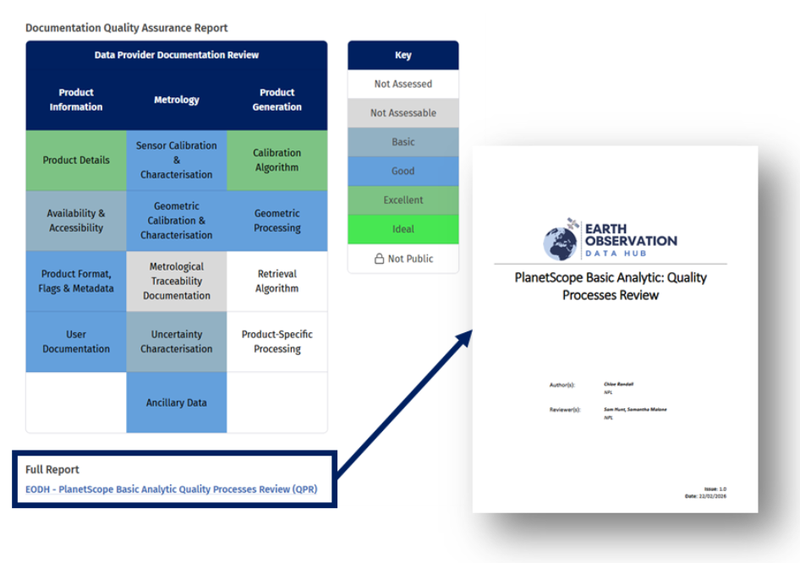
The first part of the Data Product QA consists of a review of the product’s documentation and publishes the results within a Quality Processes Review (QPR) report; this QPR report is stored in the catalogue. The purpose of the QPR is to demonstrate that the product has been developed and generated following processes that adhere to best practices.
To achieve this, the EODH Data Product QA Process adheres to the ESA/NASA EO Product QA Framework. This framework defines requirements for a variety of aspects of Data Product quality – awarding grades of Basic, Good, Excellent, or Ideal. The QPR provides the underpinning evidence justifying the awarded grades and summarises the results in a maturity matrix.
The result of this evaluation is created as a QA Check Result and added as a STAC Asset at collection-level within the EODH Catalogue for user interaction.
The Data Product QA additionally focuses on validating the various product specifications; the focus is to state whether or not a product meets its defined specification, not to compare which product is better than another for a given use-case. The EODH QA Service has been designed to be scalable in order to cover a range of possible performance metrics for the data products available on the Hub. For each validation method, there will be a Validation Workflow Description (VWD) document outlining the process and methods used to validate that performance metric.
This process is currently demonstrated through the implementation of radiometric uncertainty validation. This metric is validated by comparing the mission data to in-situ reference measurements from EO community agreed Cal/Val sites, such as RadCalNet. The radiometric uncertainty validation results are represented as a pass/partial pass/fail to represent whether the product is deemed to meet its stated specification (e.g. 5% radiometric uncertainty). The full description of the method and processing steps carried out can be found within the (VWD for Absolute Radiometric Calibration).
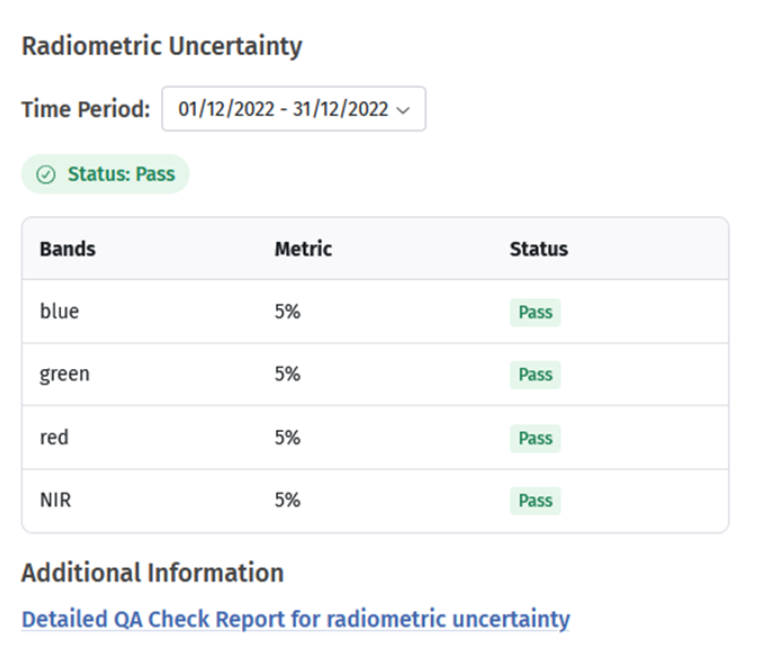
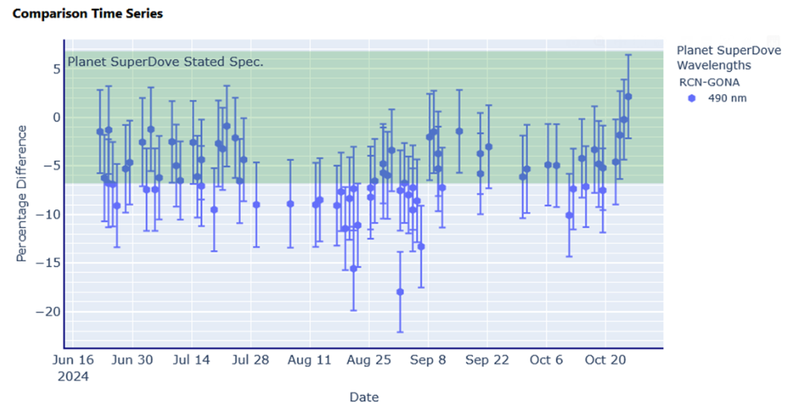
The Quality Assurance process links to the CEOS Product Validation Platform (CEOS-PVP) Radiometric Validation AnaLtyics (RadVAL) tool which offers a deeper dive, visualising the results behind this radiometric QA check.
To discover how this tool can support quality assurance read the RadVAL Dashboard case study.
The EO DataHub continues to expand its quality assurance capabilities by incorporating additional validation methods and enabling contributions from domain experts. This information is integrated direction into the DataHub experience.
Users can:
This results in a platform that maintains high standards as new datasets, providers and use cases are introduced. Integrating these with the Quality Assurance service ensures that quality is not separate from the data, but part of how it is discovered and used.